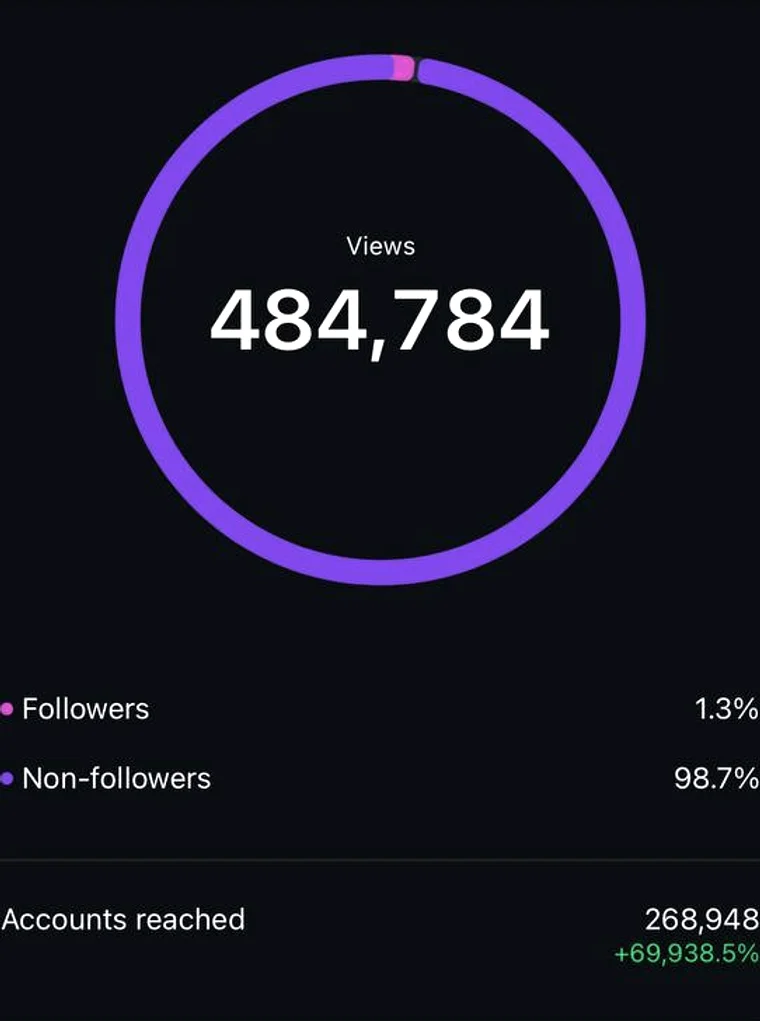
I took an old personal Instagram account where most followers were just friends, produced 8 videos with Ralphy, spent $131.77 on tokens, and got 484,784 views in the first half of June.
$0.27Cost per 1,000 views
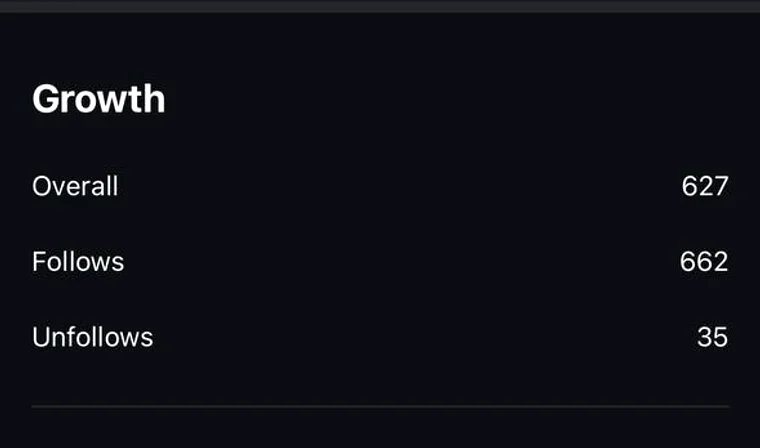
$0.21Cost per net follower
2 wksMain posting window
The first videos were not good. Some got around 500 views. I was still learning Reels, hooks, posting rhythm, and what Instagram rewards. With Ralphy I could make another attempt the same day, so I kept testing.
The setup
This was an old personal account with a small friend-following base, and then I suddenly started learning short-form video in public.
- 01
Find a viral format
I started from a format that was already working: simple choice mechanics, dark character worlds, and comments that make people pick a side.
- 02
Adapt it into my own style
The goal was not to copy a trend one-to-one. I used Ralphy to push the format into my own visual language: Silent Hill mood, weird character scenes, voxel tests, and Ralphy-vs-competitor ideas.
- 03
Use trials to validate hooks
Trial reels became the hook lab. I could post variants, watch early signals, archive tests that did not belong on the main grid, and keep the stronger ideas.
- 04
Ship the winners to the grid
The main grid got the better candidates: horror-choice formats, character prompts, localization tests, and Ralphy-brand comparisons.
- 05
Stop after getting proof
I stopped after I found the playbook for getting views. The reason was simple: the views did not become leads. Now I am changing focus from pure reach to formats that can bring users.
The result
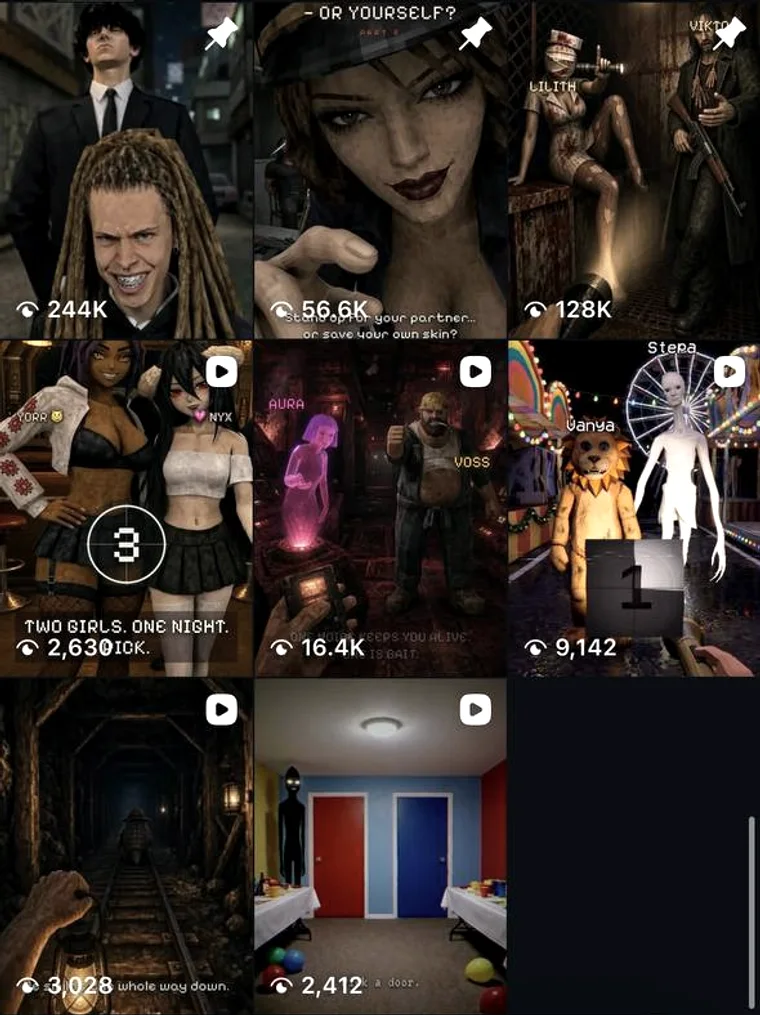
I produced 8 videos with Ralphy:
- Trafalgar, first in our style:
trafalgar-aura-001, $13.60.
- Silent Hill, episode 1:
choose-silenthill-001, $23.40.
- Silent Hill, episode 2:
choose-silenthill-002, $18.90.
- Silent Hill, episode 3:
choose-silenthill-003, $28.58.
- AI vs Engineer:
choose-spaceship-001, $17.24.
- Aethpizza localization dub:
aethpark-localize-001, $2.80.
- First voxel choose-path by the lighthouse:
choose-path-001, $16.40.
- Choose a door: Higgsfield or Ralphy:
ralphy-vs-higgsfield-001, $10.85.
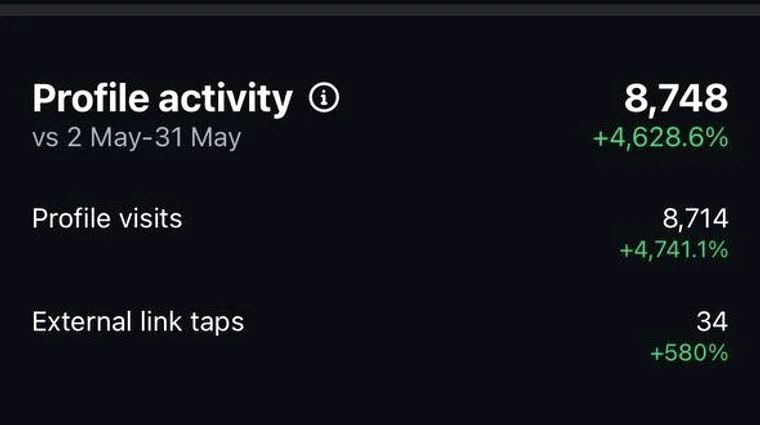
Total token spend: $131.77. Views: 484,784. Accounts reached: 268,948. Profile visits: 8,748. Net follower growth: 627.
The unit economics:
| Metric | Value |
|---|
| Cost per 1,000 views | $0.27 |
| Cost per 1,000 accounts reached | $0.49 |
| Cost per profile visit | $0.015 |
| Cost per gross follow | $0.20 |
| Cost per net follower | $0.21 |
The mistake that taught the most
One video looked strong in trials. It got roughly 10k views there, so I archived the trial and posted the exact same video on the main grid.
It flopped around 3k views. My read is simple: archiving the trial does not make Instagram treat the same asset like a fresh new post. Trial reels are useful for hook validation, but the final version needs a real remix before it goes to the main grid.
Why build the platform instead of using another route?
AI video platforms are not competitors for this result. They sell generation capacity, credits, templates, and convenience. They do not sell or guarantee views.
The comparable alternatives are different. A freelancer or agency can make videos, but the price for 8 experiments is usually thousands, and they still cannot guarantee organic reach. Paid media can buy impressions while the spend lasts, but paid impressions do not teach the same thing as a format people watch voluntarily. Hosted AI video tools can generate clips, but the hook loop, project memory, cost ledger, and repeatable workflow still live somewhere else.
This is why I chose to build Ralphy. I wanted an agent in my terminal that I could delegate the scary parts to: researching a format, writing prompts, generating variants, keeping the refs straight, logging token costs, and helping me do work I would probably avoid alone.
That was the useful part: I could learn the loop fast, find a format, adapt it, test hooks, archive mistakes, and end the sprint with half a million views for $131.77.
Build your own content loop.
The useful thing is having an agent you can hand the work to, then improve the workflow every time it ships.

I took an old personal Instagram account where most followers were just friends, produced 8 videos with Ralphy, spent $131.77 on tokens, and got 484,784 views in the first half of June.
The first videos were not good. Some got around 500 views. I was still learning Reels, hooks, posting rhythm, and what Instagram rewards. With Ralphy I could make another attempt the same day, so I kept testing.
The setup
This was an old personal account with a small friend-following base, and then I suddenly started learning short-form video in public.
Find a viral format
I started from a format that was already working: simple choice mechanics, dark character worlds, and comments that make people pick a side.
Adapt it into my own style
The goal was not to copy a trend one-to-one. I used Ralphy to push the format into my own visual language: Silent Hill mood, weird character scenes, voxel tests, and Ralphy-vs-competitor ideas.
Use trials to validate hooks
Trial reels became the hook lab. I could post variants, watch early signals, archive tests that did not belong on the main grid, and keep the stronger ideas.
Ship the winners to the grid
The main grid got the better candidates: horror-choice formats, character prompts, localization tests, and Ralphy-brand comparisons.
Stop after getting proof
I stopped after I found the playbook for getting views. The reason was simple: the views did not become leads. Now I am changing focus from pure reach to formats that can bring users.
The result
I produced 8 videos with Ralphy:
trafalgar-aura-001, $13.60.choose-silenthill-001, $23.40.choose-silenthill-002, $18.90.choose-silenthill-003, $28.58.choose-spaceship-001, $17.24.aethpark-localize-001, $2.80.choose-path-001, $16.40.ralphy-vs-higgsfield-001, $10.85.Total token spend: $131.77. Views: 484,784. Accounts reached: 268,948. Profile visits: 8,748. Net follower growth: 627.
The unit economics:
$0.27$0.49$0.015$0.20$0.21The mistake that taught the most
One video looked strong in trials. It got roughly 10k views there, so I archived the trial and posted the exact same video on the main grid.
It flopped around 3k views. My read is simple: archiving the trial does not make Instagram treat the same asset like a fresh new post. Trial reels are useful for hook validation, but the final version needs a real remix before it goes to the main grid.
Why build the platform instead of using another route?
AI video platforms are not competitors for this result. They sell generation capacity, credits, templates, and convenience. They do not sell or guarantee views.
The comparable alternatives are different. A freelancer or agency can make videos, but the price for 8 experiments is usually thousands, and they still cannot guarantee organic reach. Paid media can buy impressions while the spend lasts, but paid impressions do not teach the same thing as a format people watch voluntarily. Hosted AI video tools can generate clips, but the hook loop, project memory, cost ledger, and repeatable workflow still live somewhere else.
This is why I chose to build Ralphy. I wanted an agent in my terminal that I could delegate the scary parts to: researching a format, writing prompts, generating variants, keeping the refs straight, logging token costs, and helping me do work I would probably avoid alone.
That was the useful part: I could learn the loop fast, find a format, adapt it, test hooks, archive mistakes, and end the sprint with half a million views for $131.77.
Build your own content loop.
The useful thing is having an agent you can hand the work to, then improve the workflow every time it ships.